
 By The Precedent
The salary for interior architect roles in Australia varies by more than $70,000 depending on where you work, who you work for, and what you can document about your value. A single national average tells you almost nothing useful.
This guide breaks down pay by experience level, city, sector, and skill set, so whether you are benchmarking a job offer or preparing for a salary review, you leave with the exact figures and context you need to act.
What Defines an Interior Architect’s Pay
Interior architects hold qualifications that span both architecture and interior design. They take responsibility for spatial planning, building compliance, structural alterations, and interior specifications within a single project scope. That dual competency is broader than what most interior designers hold, and employers price it differently.
The salary for interior architect positions sits above equivalent interior designer roles at most experience levels. The gap widens with seniority, sector complexity, and registration status.
Three variables control where any individual falls within the pay range: years of experience, city of practice, and the project type the firm specialises in. Understanding all three is what turns a benchmark into a negotiation strategy.
Average Salary for Interior Architect in Australia
According to SEEK, which draws its figures directly from salary ranges disclosed by employers in job advertisements, the average architect salary in Australia sits between $90,000 and $110,000 per year.
Interior architect roles typically occupy the lower-to-middle band of that range, with the starting salary for interior architect graduates sitting closer to $55,000-$68,000 and senior practitioners pushing past $130,000 on commercial project streams.
Across aggregated market data, the working range for the salary for interior architect professionals in Australia spans roughly $64,000 at the 25th percentile to $92,500 at the 75th percentile. Top earners at the 90th percentile clear $130,600.
The salary gap between design professionals and skilled tradespeople in Australia is narrower than most people expect at the mid-career level, which is why registration status and sector specialisation remain the clearest levers for interior architects looking to separate their earnings from the broader market.
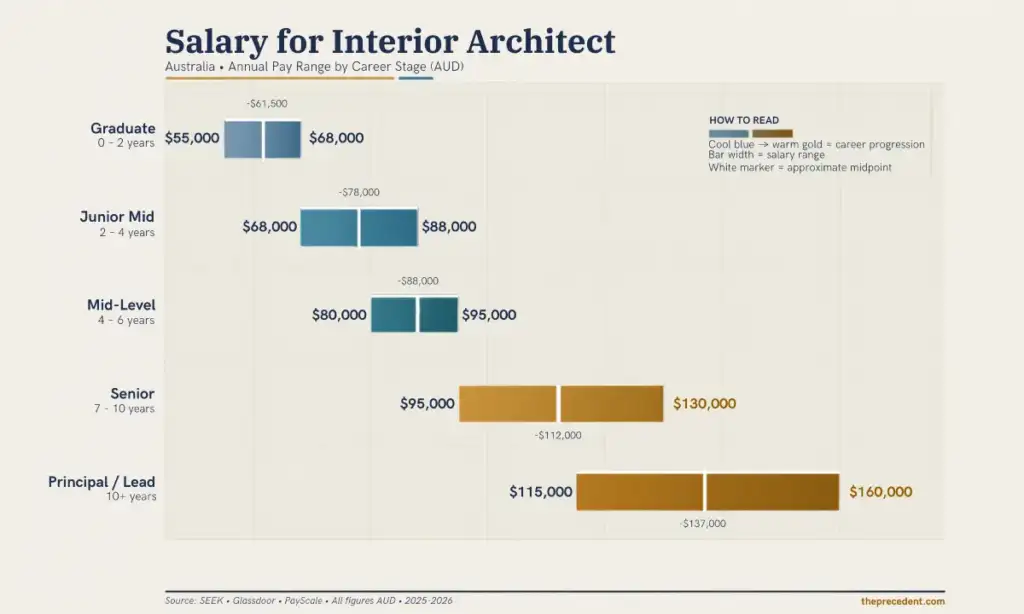
Salary for Interior Architect by Experience Level
Experience is the clearest driver of pay in this profession. Each stage unlocks a higher ceiling, and registration accelerates the jump from mid-level to senior pay.
Graduate (0-2 Years)
The salary for interior architect graduates sits between $55,000 and $68,000. Most graduate roles fall under the Fair Work Architects Award (MA000079), which sets the minimum classification floor.
Software proficiency is the primary differentiator at this level. Firms running Revit or ArchiCAD-based BIM workflows typically offer graduates 8-12% above studios still operating on 2D CAD documentation.
Mid-Level (3-6 Years)
Mid-level practitioners with delivered projects on their portfolio earn between $75,000 and $95,000. The ability to manage documentation independently and take on client-facing responsibilities pushes salaries to the top of that band.
Board registration is the most impactful credential at this stage. Registered practitioners carry legal liability that unregistered staff cannot, and firms factor that into the offer.
Senior (7+ Years)
The salary for interior architect professionals at the senior level ranges from $95,000 to $130,000+. Those who lead project teams, manage junior staff, or own client relationships negotiate packages at the higher end.
Sector specialisation in hospitality, healthcare, or high-end residential commands premiums that generalist senior experience alone does not.
Salary for Interior Architect by City
Location produces measurable pay differences, though cost of living always needs factoring into any comparison.
| City | Typical Annual Range (AUD) | Key Driver |
| Sydney | $75,000 – $130,000 | High-volume commercial and hospitality sector |
| Melbourne | $70,000 – $110,000 | Strong hospitality, retail, and mixed-use pipeline |
| Brisbane | $65,000 – $100,000 | Growing infrastructure investment; lower cost of living |
| Perth | $65,000 – $105,000 | Resource sector and government project demand |
| Canberra | $70,000 – $115,000 | Strong public sector project volume |
| Adelaide | $60,000 – $90,000 | Competitive on lifestyle-adjusted comparisons |
Sydney produces the highest absolute salary for interior architect roles because commercial and hospitality project budgets are larger, which flows directly into fee rates and staff costs. Brisbane and Perth are narrowing that gap as infrastructure spending increases.

Interior Architect vs Interior Designer: Pay Compared
This is one of the most searched sub-questions from people weighing which pathway to pursue, and the answer is consistent across the market.
The salary for interior architect roles runs 10-20% above equivalent interior designer positions at the same experience level. The premium reflects the additional regulatory competency, the ability to lodge construction certificates, and the broader structural scope interior architects carry.
Interior designers in Australia typically earn around $92,100 per year on average, with a range running from approximately $48,300 to $140,700.
Senior interior architects working on commercial or institutional projects regularly exceed that ceiling. At the graduate level, the gap is smaller and often comes down to the firm type rather than the job title itself.
One important caveat: “interior architect” is not a protected title in every Australian state. Some employers use both titles interchangeably, which distorts aggregated salary data. When evaluating any offer, look at the duties described in the contract, not the title on the header.
Salary by Sector: Commercial, Residential, and Government
Commercial and Hospitality
Commercial interior architecture produces the highest salary for interior architect roles. Larger project budgets allow firms to sustain higher headcount costs, and delivery pressure rewards people who perform accurately under time constraints. Experienced commercial interior architects in Sydney and Melbourne regularly negotiate packages between $100,000 and $130,000.
Sydney studios operating at this level illustrate the point well. 3Xi Studio, an award-winning Sydney-based practice working globally, operates across hospitality, residential, and commercial projects, the exact project mix that drives salary at the higher end of the market. Interior architects embedded in studios of that calibre and scope command compensation that reflects both the complexity of the work and the international client expectations attached to it.
High-End Residential
Bespoke residential work pays well at the senior end but offers lower salaries for entry and mid-level practitioners. Boutique residential studios typically run lean operations, and junior staff absorb overhead on lower-margin projects.
Government and Institutional
Government roles offer stability and pay tied to public service salary frameworks. Public sector employees in Australia earn approximately 5% more than their private sector counterparts in equivalent roles. The trade-off is slower career progression and reduced design autonomy compared to private practice.
Healthcare is a high-growth sub-sector. Interior architects with knowledge of infection-control design standards and AHPRA-adjacent compliance requirements are scarce, and firms price that scarcity into their offers.
Skills That Push Salary Higher
Specific technical and leadership skills consistently appear in higher-paying interior architect job ads. These are worth prioritising at every career stage.
BIM Proficiency (Revit, ArchiCAD): Firms running full BIM workflows pay 8-15% above those that do not. BIM coordination across architecture, structure, and services is now the baseline expectation on commercial projects above $1M in construction value.
Green Star and NCC Section J Knowledge: Sustainability accreditation adds value in government and institutional tendering. Firms chasing public work need practitioners who understand compliance, not just design intent.
Project and Client Management: Interior architects who run client meetings, manage programmes, and write consultant briefs reduce principal overhead. Firms pay for that independence because it directly affects their capacity to take on more work.
Specification and Tender Documentation: Accurate specifications reduce variation claims and procurement disputes. Practitioners with a reputation for clean documentation attract senior roles faster than those who rely on others to close documentation gaps.
Sector Compliance Knowledge: Healthcare, education, and aged care carry specific compliance layers above the NCC baseline. Knowing those frameworks makes a practitioner valuable in ways that cannot be quickly substituted.
How to Negotiate the Salary You Deserve
Most interior architects accept below-market pay not because they lack leverage, but because they enter the conversation without verifiable data and without a clear account of the value they produce.
- Anchor to current advertised roles. Pull salary figures from SEEK job ads for your city and experience band. A request grounded in what employers are actively offering today carries more weight than a personal expectation figure.
- Quantify your project contribution. Firms understand fees and margins. Connecting your work to reduced rework, on-time delivery, or retained clients speaks the employer’s language. “I coordinated documentation on a $3.5M commercial fit-out delivered on programme and under the consultant budget” is negotiation leverage.
- Choose the right moment. After a successful project delivery or a positive review is the strongest position from which to negotiate. A calendar-driven request with no project context is the weakest.
- Assess the total package. Base salary is one component. Super above the 11.5% SG rate, CPD allowances, software subscriptions, profit-sharing, and flexible hours all contribute to real take-home value. A $90,000 package with CPD coverage and flexibility can outperform a $100,000 offer without them.
- Name your registration status. If you are board-registered and your employer has not explicitly factored that into your pay, raise it. Registration carries legal liability that unregistered colleagues cannot assume, and it deserves to be reflected in your compensation.

Conclusion
The salary for interior architect roles in Australia ranges from around $55,000 at the graduate level to $130,000+ for senior practitioners on commercial project streams, with city, sector, registration, and skill set determining exactly where any individual lands. Using those variables to benchmark your own position, rather than relying on a single national average, is what gives you both the clarity to evaluate an offer accurately and the confidence to negotiate from a position of real knowledge.