
 By The Precedent
You stare at your living room, and something feels off. The furniture is fine. The colors are fine. But the space just does not feel like you.
You search for inspiration, open Instagram, bookmark 47 photos, and end up more confused than when you started. Now you have a mood board of completely contradictory ideas and zero clue how to execute any of them.
As a Creative Property Stylist in Sydney, I see this exact problem in almost every home I walk into. Here is the truth: most people jump straight to buying furniture before answering two fundamental questions. What design style actually fits my life? And what is the correct order of decisions to make? Get those two things right, and everything else falls into place.
TL;DR: What Are the 4 Types of Interior Design?
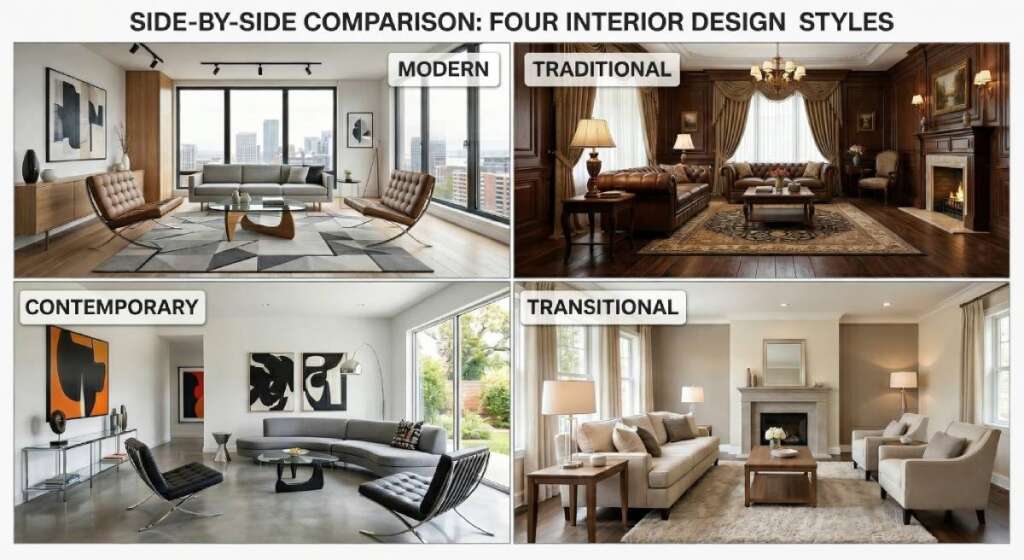
The 4 core types of interior design are Modern, Traditional, Contemporary, and Transitional. Each style is defined by its use of form, materials, colour palette, and ornamentation. Most real-world spaces are a blend, but identifying your dominant style is the essential first step before any design decision.
The 4 Core Types of Interior Design (Explained Clearly)
Before you choose a paint colour or a sofa, you need a style anchor. Without one, your space becomes a visual argument between pieces that do not belong together. Here is a precise breakdown of each type.
1. Modern Interior Design
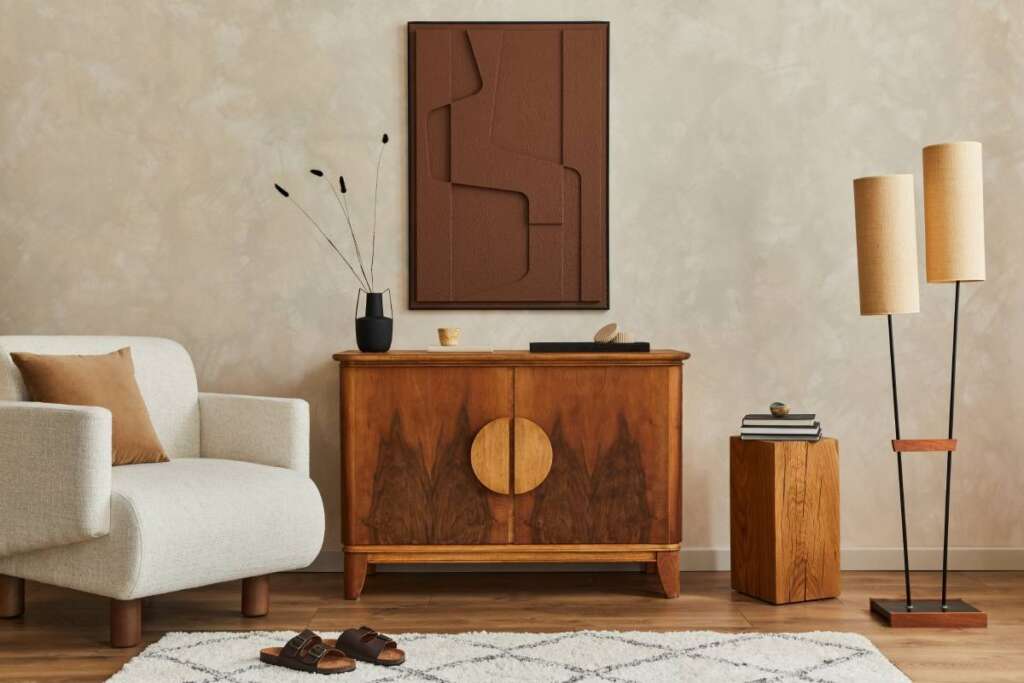
What it is: Modern design refers specifically to the design movement of the early-to-mid 20th century, rooted in Bauhaus and mid-century aesthetics. It is not a synonym for “current.” It has a defined visual language.
Key characteristics:
- Form follows function — every element has a purpose, nothing decorative for its own sake
- Clean horizontal and vertical lines with no ornate detailing
- Neutral palette: warm whites, tans, greys, with earthy accent tones
- Natural materials: wood, leather, linen, wool
- Open floor plans with uncluttered negative space
Best for: People who find peace in order and dislike visual noise. Think Frank Lloyd Wright’s Prairie houses, or a classic mid-century living room with a low-profile walnut credenza.
2. Traditional Interior Design
What it is: Traditional design draws from 18th and 19th century European influences, particularly English and French styles. It is the opposite of minimalism. It uses richness, symmetry, and curated layers to create warmth.
Key characteristics:
- Symmetrical arrangements — paired armchairs, matching lamps, balanced artwork
- Dark, rich wood furniture with carved detailing and cabriole legs
- Warm colour palettes: deep reds, navy, forest green, camel, burgundy
- Pattern mixing: florals, plaids, stripes used with intention
- Formal fabrics: velvet, damask, silk, heavy linen
Best for: Those who love collected, layered spaces that feel timeless rather than trendy. Traditional design signals permanence and craftsmanship.
3. Contemporary Interior Design
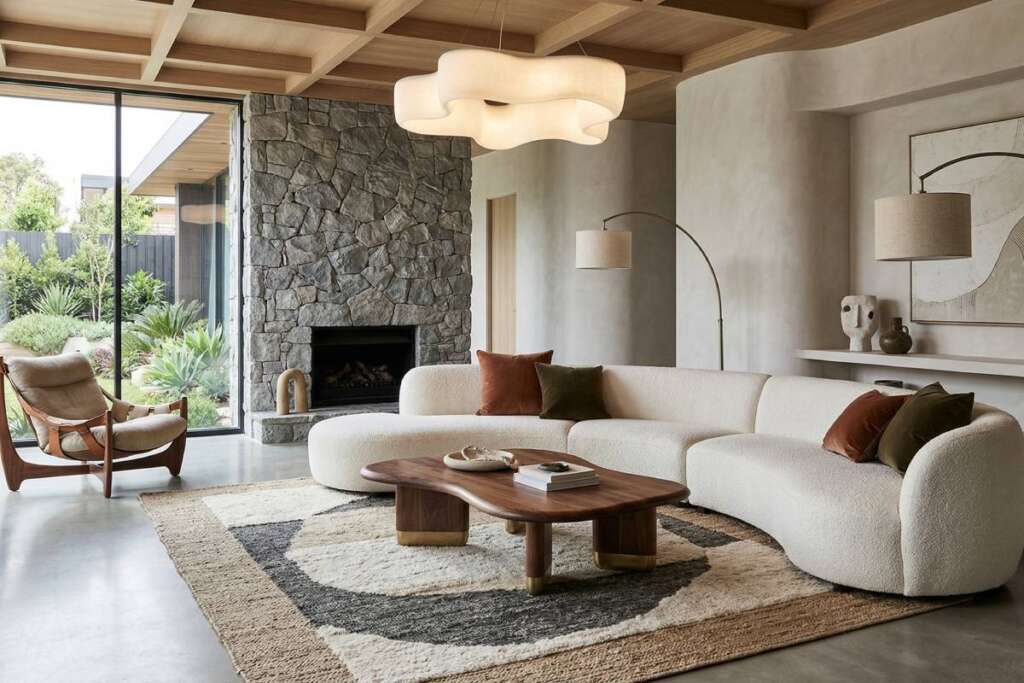
What it is: Contemporary means what is happening right now, today. Unlike “Modern,” it is not a fixed style. It is a moving target that reflects current trends. As of now, contemporary design leans into organic shapes, textural contrast, and sustainability.
Key characteristics:
- Curved, biomorphic furniture shapes (goodbye, sharp corners)
- Bold colour in controlled doses: saturated accent walls, statement sofas
- Mixed materials: concrete with bouclé, steel with rattan
- Heavy texture play — think Japandi influence: calm, earthy, tactile
- Minimal ornamentation but strong visual focal points
Best for: Design-forward people who want their space to feel current and evolving. The risk is dating quickly. The reward is feeling genuinely of this moment.
4. Transitional Interior Design
What it is: Transitional is the most livable and commercially dominant style in North America. It bridges the warmth of Traditional with the cleanliness of Modern. Think of it as the intelligent middle ground.
Key characteristics:
- Neutral, layered palettes: greige, soft white, warm grey, taupe
- Clean-lined furniture with subtle curves, no heavy ornamentation
- Mixed materials without extremes — no stark industrial, no heavy antique
- Comfort-forward: plush sofas, upholstered headboards, layered textiles
- Artwork and decor that feels curated but approachable
Best for: Families, resale-focused homeowners, and anyone who loves comfort without committing to a polarising aesthetic. It photographs beautifully and sells homes.
Side-by-Side Comparison of the 4 Design Styles
| Style | Key Principle | Signature Materials | Color Palette | Best For |
| Modern | Form follows function | Walnut, leather, linen | Warm neutrals, earth tones | Minimalists, mid-century fans |
| Traditional | Richness and symmetry | Dark wood, velvet, damask | Deep jewel tones, warm earth | Layered, timeless interiors |
| Contemporary | Current design trends | Concrete, rattan, bouclé | Bold accents on neutrals | Trend-aware, design-forward |
| Transitional | Comfortable balance | Mixed, soft-lined pieces | Greige, taupe, soft white | Families, resale value |
How to Do Interior Design Step by Step
Knowing the styles is the foundation. Executing a design is the structure built on top. Most people get this process backwards, which is why rooms feel inconsistent. Follow this sequence precisely.
Step 1: Audit Your Space Before You Touch Anything
Measure every wall, doorway, window, and ceiling height. Note which direction natural light enters and at what times of day. Photograph every corner.
This audit answers the questions that determine every decision that follows:
- What is the traffic flow through this room?
- Where is the natural focal point (fireplace, window, feature wall)?
- What architectural features can you work with versus around?
Pro tip: Use free tools like Roomstyler or Planner 5D to create a digital floor plan. Rearranging furniture on screen costs nothing. Rearranging furniture in real life costs your back.
Step 2: Define Your Style (Use the Third Rule)
Revisit the four styles above. Now apply the Third Rule: your space should be 60% one dominant style, 30% a secondary style, and 10% wild card or personal accent.
This ratio prevents rooms from feeling like a showroom (too rigid) or a storage unit (too chaotic). It is the same formula professional designers use, whether they articulate it or not.
Exercise: Go through your saved inspiration images and tag each one with a style label. Whichever label appears most often is your dominant style. Do not override that data with what you think you should like.
Step 3: Establish Your Colour Strategy
Colour is not decoration. Colour is the structural foundation of a room’s mood. Decide on your colour story before purchasing a single piece of furniture.
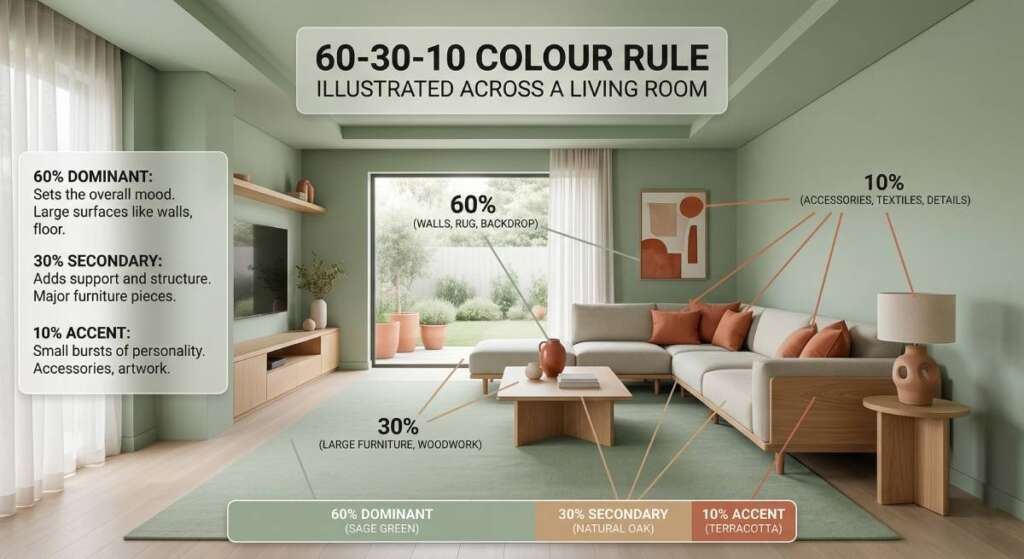
Follow the 60-30-10 colour rule:
- 60% — Dominant colour. Usually walls, large rugs, and main sofa.
- 30% — Secondary colour. Upholstered chairs, drapery, accent furniture.
- 10% — Accent colour. Throw pillows, artwork, plants, small decor objects.
Avoid the most common mistake: choosing your paint colour last. Paint should be chosen to complement your fixed, expensive anchor pieces — your sofa, your flooring, your cabinetry.
Step 4: Choose Your Anchor Piece First
Every room needs a single anchor piece — the largest, most visually dominant element around which everything else is organised. In a living room, it is usually the sofa. In a bedroom, the bed and in a dining room, the table.
This piece sets three non-negotiable constraints for the rest of the room:
- Scale — everything else must work proportionally to this piece
- Tone — the warm or cool undertone it introduces
- Material — the material family that opens or closes the door to
Buy your anchor piece first. Then build outward. Never backward.
Step 5: Layer Lighting (Most People Skip This Entirely)
A room designed entirely under overhead lighting is a room that will always feel flat. Professional designers think in three layers of light:
- Ambient lighting — General illumination. Overhead fixtures, recessed lighting.
- Task lighting — Functional light for specific activities. Reading lamps, under-cabinet lights.
- Accent lighting — Decorative light that creates depth. Picture lights, sconces, and LED strips.
Rule of thumb: Every room should have at least one light source in each of the three layers. Use dimmers wherever possible. The ability to control light intensity is more valuable than the fixture itself.
Step 6: Apply Scale and Proportion Principles
Scale refers to the size of an object relative to the room. Proportion refers to the size relationship between objects. Violating these principles is the most common reason a room feels wrong, even when individual pieces are beautiful.
Critical rules:
- Artwork should be 2/3 to 3/4 the width of the furniture it hangs above
- A rug should extend at least 6 to 8 inches beyond the sofa on each side
- Ceiling height determines maximum furniture height — tall rooms need taller furniture
- Leave 18 inches of walkway clearance between any two pieces of furniture
Step 7: Add Texture and Pattern in Controlled Layers
Once your anchor furniture is placed and your colour palette is locked, texture becomes your most powerful remaining tool. It is what separates a designed room from a furnished room.
Target at least 5 different textures per room:
- Hard (wood, metal, glass, ceramic)
- Soft (fabric, velvet, bouclé, linen)
- Natural (rattan, jute, linen, stone)
- Reflective (mirrors, metallic accents, lacquered surfaces)
- Living (plants, dried botanicals)
Step 8: Edit Ruthlessly
The final step most people never take. Once everything is placed, remove one item from every surface. Then evaluate. Almost universally, the room looks better.
The edit is the design. Constraint is not a limitation in interior design. It is the tool professionals use to create the sense of intention that makes a space feel finished rather than accumulated.
The Complete Interior Design Process at a Glance
| Step | Action | Key Decision |
| 1 | Audit your space | Measure, photograph, map traffic flow |
| 2 | Define your style | Apply the 60-30-10 style ratio |
| 3 | Build your colour strategy | Choose palette before purchasing furniture |
| 4 | Select your anchor piece | One dominant piece sets all constraints |
| 5 | Layer your lighting | Ambient, task, and accent in every room |
| 6 | Apply scale and proportion | Follow furniture-to-room size rules |
| 7 | Add texture and pattern | Target 5 distinct textures per space |
| 8 | Edit ruthlessly | Remove until the room breathes |
Final Thoughts
Interior design is not about having expensive taste. It is about making intentional decisions in a deliberate sequence. Most rooms fail because the decisions were made in the wrong order, not because the budget was too small or the pieces were wrong.
Start with your style anchor. Then your colour strategy and your anchor piece. Then build outward in layers. Every professional designer on earth is doing some version of this sequence, regardless of the style or budget.
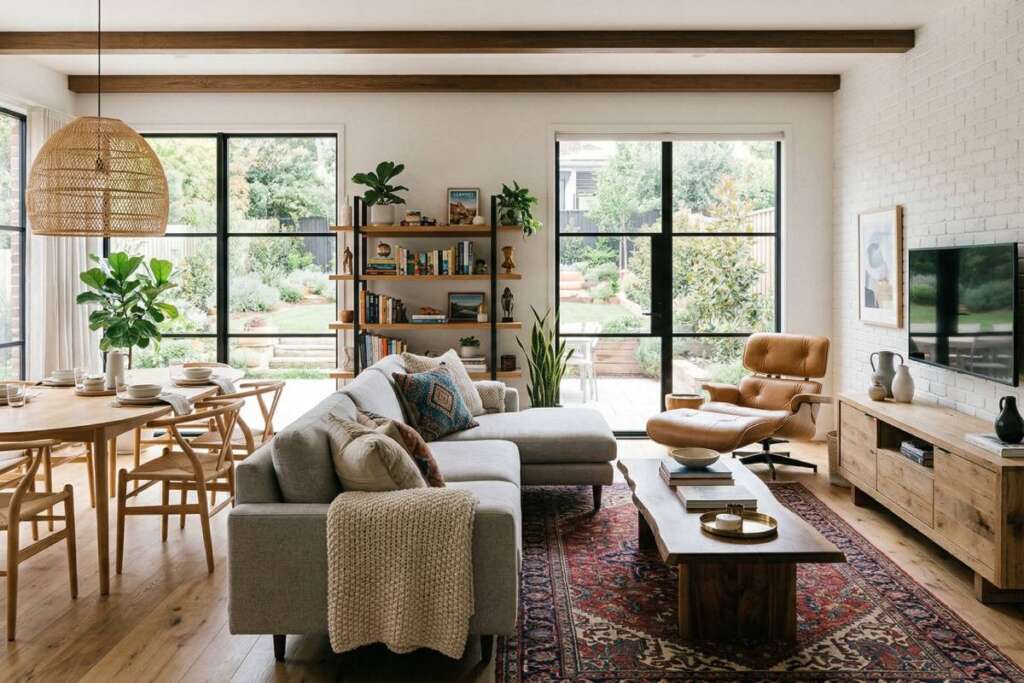
The four style types give you a framework for making decisions faster and with more confidence. Once you know you are designing a Transitional space, every ambiguous choice becomes easier. You have a filter.
Thought to leave you with: If you removed every piece of furniture from your current space today, which of the 4 design styles would the bones of your home naturally support? And how different is that from what you have been trying to create?